Your core is not just your abdominal muscles - it is the entire cylinder of muscles that wraps around your midsection, supporting your spine, controlling your balance, and powering nearly every movement you make. After 50, core strength becomes even more critical for posture, fall prevention, and everyday activities. This guide explains why it matters and gives you six exercises you can start today.
For the full picture on building strength across your whole body, see our complete guide to strength training over 50.
What Your Core Actually Does
When most people think of core training, they picture sit-ups and six-pack abs. But your core is a complex system of muscles that includes:
- Rectus abdominis: The "six-pack" muscles at the front of your abdomen
- Obliques: The muscles on each side that enable rotation and side-bending
- Transverse abdominis: A deep muscle that wraps around your torso like a natural corset, providing stability
- Erector spinae: The muscles running along your spine that keep you upright
- Pelvic floor: The muscles at the base of your core that support your internal organs
- Diaphragm: Your primary breathing muscle, which also contributes to core stability
A strong core is not about how your midsection looks. It is about how well these muscles work together to stabilise your spine, transfer force between your upper and lower body, and keep you balanced during movement.
Why Core Strength Matters More After 50
Core strength affects almost everything you do:
- Balance and fall prevention: Your core muscles make constant adjustments to keep you upright. Weak core muscles are a significant risk factor for falls. Our guide to building balance confidence explains this connection in detail.
- Back pain prevention: A weak core forces your spine to bear loads it was not designed to handle alone, leading to chronic back pain
- Posture: Core muscles hold your spine in alignment. Without them, you gradually develop the forward-leaning posture that makes you look and feel older than you are
- Daily activities: Getting out of bed, bending to tie shoes, carrying shopping, reaching overhead - all require core engagement
- Breathing: Good core function supports the diaphragm, which means better breathing efficiency during exercise and daily life
6 Core Exercises for Over 50s
These exercises strengthen your core without the spinal stress of traditional sit-ups. You need only an exercise mat or towel.
Exercise 1: Dead Bug
Lie on your back with arms extended toward the ceiling and knees bent at 90 degrees. Slowly lower your right arm behind your head while extending your left leg toward the floor, keeping your lower back pressed firmly into the mat. Return to the starting position and repeat on the opposite side. Perform 8-10 repetitions per side.
Why it works: The dead bug teaches your core to stabilise while your limbs move - exactly what happens during walking, reaching, and lifting.
Exercise 2: Bird Dog
Start on all fours with hands under shoulders and knees under hips. Extend your right arm forward and left leg backward simultaneously, keeping your back flat and hips level. Hold for 2-3 seconds, then return. Repeat on the opposite side. Perform 8-10 repetitions per side.
Why it works: This builds anti-rotation stability - your core works to prevent your torso from twisting as you extend opposite limbs.
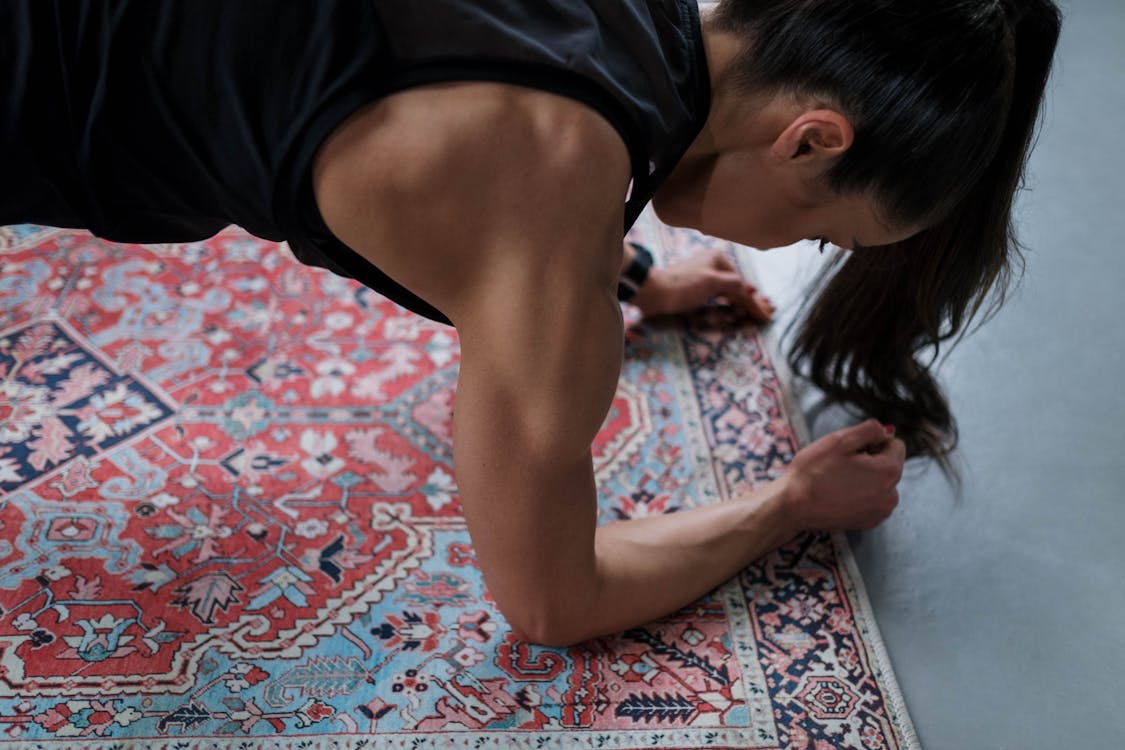
Exercise 3: Modified Plank (Knees Down)
Position yourself face down, resting on your forearms with elbows under shoulders and knees on the mat. Lift your hips until your body forms a straight line from shoulders to knees. Hold this position, breathing steadily, for 15-30 seconds. Rest and repeat 3 times.
Progression: As you get stronger, move to a full plank on your toes. Build hold time gradually - 30 seconds with good form is better than 60 seconds with sagging hips.
Exercise 4: Glute Bridge with Hold
Lie on your back with knees bent and feet flat on the floor, hip-width apart. Push through your heels to lift your hips until your body forms a straight line from shoulders to knees. Hold at the top for 3-5 seconds, squeezing your glutes and engaging your core. Lower with control. Perform 10-12 repetitions.
Why it works: The glute bridge strengthens both your core and posterior chain, which work together to support your spine.
Exercise 5: Seated Rotation
Sit on the floor with knees slightly bent, feet flat. Hold your hands together at chest level or hold a light weight. Lean back slightly, engaging your core. Rotate your torso to the right, bringing your hands toward the floor beside your hip. Return to centre and rotate left. Perform 8-10 rotations per side.
Why it works: Rotational core strength supports turning movements - looking behind you while driving, reaching across your body, and maintaining balance on uneven ground.
Exercise 6: Side-Lying Hip Lift
Lie on your side with your bottom forearm on the mat, elbow under shoulder. Stack your knees (bent at 90 degrees for the modified version). Lift your hips off the mat until your body forms a straight line from shoulders to knees. Hold for 10-15 seconds. Lower and repeat 3 times per side.
Why it works: This targets your obliques, which are essential for lateral stability - the ability to stay upright when you step sideways or catch your balance.
Your 20-Minute Core Routine
Perform these exercises in order, resting 30 seconds between exercises:
- Dead bugs: 2 sets of 10 per side
- Bird dogs: 2 sets of 10 per side
- Modified plank: 3 holds of 20-30 seconds
- Glute bridge with hold: 2 sets of 12
- Seated rotation: 2 sets of 10 per side
- Side-lying hip lift: 3 holds of 15 seconds per side
You can do this routine 3-4 times per week. Core muscles recover faster than larger muscle groups, so daily light core work is also fine.
Exercises to Avoid for Core Training After 50
Not all traditional core exercises are suitable:
- Traditional sit-ups: They place excessive stress on your lower back and hip flexors while minimally engaging your deeper core muscles
- Leg raises from flat on the floor: Unless your core is already very strong, these strain the lower back
- Standing twists with a bar across your shoulders: This can stress your spine when combined with rotation
The six exercises above provide comprehensive core training without these risks. They strengthen your core as it naturally functions - as a stabiliser, not a sit-up machine.
Frequently Asked Questions
How often should I train my core?
Three to four times per week is ideal. Core muscles recover faster than larger muscle groups like your legs or back, so more frequent training is appropriate. You can do a dedicated core session or add core exercises to the end of your upper body or lower body sessions.
Will core exercises give me visible abs?
Core training strengthens the muscles but visible abdominal definition depends primarily on body fat levels, which are influenced more by overall diet and exercise than by specific core exercises. The real benefit of core training after 50 is improved function, balance, and pain prevention - not cosmetic changes.
Can core exercises help with my back pain?
Often, yes. Chronic lower back pain is frequently associated with weak core muscles. Strengthening your deep core (particularly the transverse abdominis) provides better spinal support and can significantly reduce back pain. However, if you have a specific back condition, consult your GP or physiotherapist before starting. Our guide on strength training with chronic conditions covers back pain adaptations in detail.
References
- NHS. Strength and flexibility exercises. nhs.uk
- Chartered Society of Physiotherapy. Exercise advice. csp.org.uk
- NHS. Falls - Prevention. nhs.uk