Resistance bands are one of the most underrated tools for strength training. Lightweight, portable, and remarkably effective, they offer a joint-friendly way to build strength without the intimidation factor of a weights room. This guide covers everything you need to get started: choosing the right bands, seven essential exercises, a sample 20-minute routine, and how to progress as you get stronger.
Resistance bands are one of several options we cover in our comprehensive strength training guide, which provides the full picture of building strength after 50.
Why Resistance Bands Work So Well
Unlike free weights, which provide constant resistance throughout a movement, bands use variable resistance. The further you stretch a band, the harder it gets. This matches how your muscles naturally work - strongest at full contraction - making bands particularly effective for building functional strength.
Research from the British Journal of Sports Medicine shows that resistance band training produces strength gains comparable to traditional weight training. For adults over 50, bands offer additional advantages:
- Joint-friendly: No heavy loads compressing your joints at the start of movements
- Controlled eccentric phase: The band helps you control the lowering phase, reducing injury risk
- Portable: Pack them in a suitcase or keep a set at the office
- Affordable: A complete set costs less than one month of most gym memberships
- Versatile: Dozens of exercises possible with a single set
Choosing the Right Bands
Bands come in different styles and resistance levels. Here's what you need to know:
Band Types
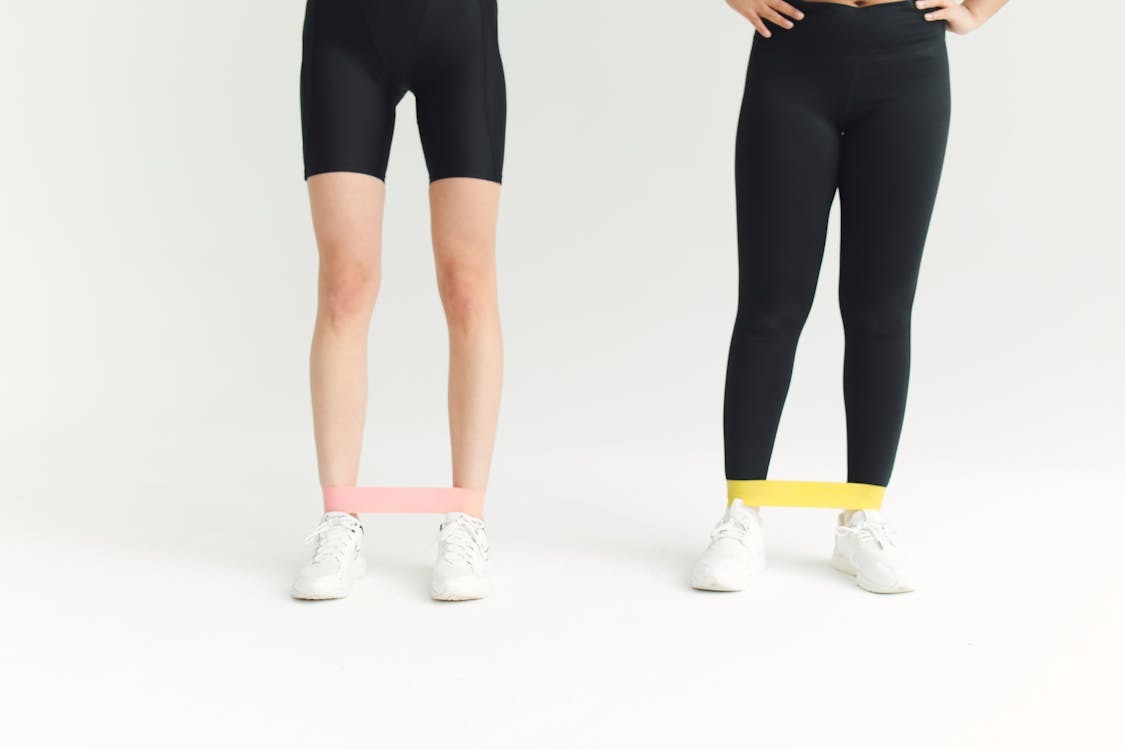
- Loop bands (mini bands): Small circles used mainly for lower body work and activation exercises
- Long loop bands: Large loops (often used for pull-up assistance) that work for full-body exercises
- Tube bands with handles: Tubes with built-in handles, convenient for many upper body exercises
- Flat therapy bands: Flat strips without handles, often used in rehabilitation
For general strength training, tube bands with handles or long loop bands offer the most versatility.
Resistance Levels
Bands are typically colour-coded by resistance, though colours vary between brands. A typical progression:
- Light (yellow/green): 2-5kg equivalent - good for arm exercises, rehabilitation, warming up
- Medium (red/blue): 5-15kg equivalent - suitable for most upper body exercises
- Heavy (black/purple): 15-25kg equivalent - lower body work, stronger individuals
- Extra heavy: 25kg+ equivalent - advanced training, assisted exercises
Start with a set of three bands (light, medium, heavy). You'll use different resistances for different exercises and body parts.
7 Essential Resistance Band Exercises
These seven movements cover all major muscle groups and form a complete strength programme. Master these, and you can train effectively anywhere.
1. Banded Squat
Works: Quadriceps, hamstrings, glutes
Stand on the centre of a long band with feet shoulder-width apart. Hold the band at shoulder height, either by looping it over your shoulders or holding the ends in your hands. Perform a squat as normal - the band adds resistance throughout the movement, making the top portion more challenging. Keep your chest lifted and weight in your heels. Complete 10-15 repetitions.
2. Standing Chest Press
Works: Chest, shoulders, triceps
Anchor the band behind you at chest height (around a door handle or sturdy post). Hold a handle in each hand and step forward until there's tension. Push both hands forward until your arms are extended, then return with control. This mimics a bench press while standing, engaging your core for stability. Complete 10-15 repetitions.
3. Seated Row
Works: Back, rear shoulders, biceps
Sit on the floor with legs extended. Loop the band around your feet and hold the ends or handles. Sit tall with a straight spine. Pull your elbows back, squeezing your shoulder blades together at the end of the movement. Release slowly. This builds the back strength essential for good posture. Complete 10-15 repetitions.
4. Shoulder Press
Works: Shoulders, triceps, upper back
Stand on the band with feet hip-width apart. Hold the handles at shoulder height with palms facing forward. Press straight up until arms are fully extended, then lower with control. Avoid arching your lower back - engage your core throughout. Complete 10-12 repetitions.
5. Bicep Curl
Works: Biceps, forearms
Stand on the band with feet together. Hold the handles with palms facing forward, arms at your sides. Curl your hands toward your shoulders, keeping your elbows pinned to your sides. Lower slowly - the eccentric phase is where much of the strength benefit occurs. Complete 12-15 repetitions.
6. Tricep Extension
Works: Triceps
Hold one end of the band behind your lower back. With your other hand, hold the band behind your head. Extend your arm upward, straightening at the elbow. Lower with control. Keep your elbow pointing forward throughout. Complete 10-12 repetitions each arm.
7. Glute Bridge with Band
Works: Glutes, hamstrings, core
Lie on your back with knees bent and feet flat. Place a mini band just above your knees. Push through your heels to lift your hips while pressing your knees outward against the band. Squeeze your glutes at the top, then lower with control. The band adds abduction resistance, activating more of the gluteal muscles. Complete 15-20 repetitions.
Sample 20-Minute Routine
This complete workout hits every major muscle group. Perform it 2-3 times per week with rest days between sessions.
Warm-Up (3 minutes)
- March on the spot: 1 minute
- Arm circles: 30 seconds each direction
- Hip circles: 30 seconds each direction
Main Workout (15 minutes)
Complete 2 rounds of the following circuit, resting 30-60 seconds between exercises and 90 seconds between rounds:
- Banded Squat: 12 reps
- Seated Row: 12 reps
- Standing Chest Press: 12 reps
- Shoulder Press: 10 reps
- Glute Bridge with Band: 15 reps
- Bicep Curl: 12 reps
- Tricep Extension: 10 reps each arm
Cool-Down (2 minutes)
- Gentle stretching for worked muscles
- Deep breathing to lower heart rate
When and How to Progress
Your muscles adapt to resistance over time. To continue building strength, you need to progressively increase the challenge. Signs you're ready to progress:
- You can complete all prescribed reps with good form and the last few don't feel challenging
- You no longer feel muscle fatigue by the end of a set
- The exercise feels "easy" compared to when you started
How to Increase Difficulty
- Use a heavier band: Move up to the next resistance level
- Double up bands: Use two bands simultaneously for combined resistance
- Slow the tempo: Take 3-4 seconds on each phase for more time under tension
- Add repetitions: Increase from 12 to 15, then 15 to 20
- Shorten the band: Grip closer to the anchor point for more tension at the start
- Add a pause: Hold the contracted position for 2-3 seconds each rep
Care and Safety Tips
With proper care, quality bands last for years. Poor maintenance or misuse can lead to snapped bands and potential injury.
Band Care
- Inspect before use: Check for small tears, worn areas, or discolouration
- Store properly: Keep away from direct sunlight and heat, which degrade rubber
- Clean occasionally: Wipe with a damp cloth; avoid oils and solvents
- Replace when worn: A snapped band can cause injury - don't risk it
Safe Exercise Practices
- Secure your anchor: Ensure doors are locked, furniture is stable
- Check your grip: Dry hands grip better; consider grip pads for sweaty hands
- Control the release: Never let a band snap back - control every phase
- Maintain posture: The resistance can pull you off balance - stay engaged
Frequently Asked Questions
Are resistance bands as effective as weights?
Research shows comparable strength gains between bands and weights for most exercises. Bands may actually be superior for building strength at the end range of motion, where muscles are fully contracted. They're a legitimate training tool, not a compromise.
How often should I replace my bands?
With regular use and proper care, quality bands typically last 1-2 years. Replace immediately if you notice any tears, cracks, or signs of wear. Bands become less elastic over time, so if your heavy band feels like a medium, it's time to replace.
Can I use bands if I have arthritis?
Bands are often recommended for people with arthritis because they're gentler on joints than heavy weights. Start with light resistance and focus on controlled movements. If specific exercises cause joint pain (not muscle fatigue), modify or skip them.
For those interested in comparing home training with gym options, see our guide to home versus gym workouts. Bands are a cornerstone of effective home training, but understanding your options helps you make informed decisions.
References
- NHS. Strength and flexibility exercises. nhs.uk
- British Journal of Sports Medicine. Resistance band training research. bjsm.bmj.com
- Chartered Society of Physiotherapy. Exercise advice. csp.org.uk